

Word Count: 2868 | Reading Time: 10 min
Content Warning: Mentions of Intimate Partner Violence, Sexual Assault, and Physical Abuse
South Asian folklore is full of stories about the monstrous feminine. From the shape-shifting jinns of Islamic mythology to the many female spirits of regional folkloric traditions—petni and shakchunni in Bengal; yakshi in the coastal Deccan; and dayaan, churail, and pichal peri in North India and Punjab—the deep-rooted fear of female agency, sexuality, desire, and rebellion in patriarchal societies has always found form in fierce, vengeful, supernatural female entities. The resurgence of women-centric horror films in South Asia is a reflection of this phenomenon. As a new wave of antifeminism sweeps through the region, South Asian filmmakers are turning to folk, gothic, and psychological horror frameworks because they offer a visual and symbolic language that can examine socio-political issues which social realism alone cannot fully articulate.
[Embed: Hawa-হাওয়া | Trailer | Chanchal Chowdhury, Nazifa Tushi | Mejbaur Rahman Sumon | Maasranga Movies]
This is especially true for India and Bangladesh. Recent films such as Bulbbul (2020), Lalanna’s Song (2025), and Bokshi (2025) from India and Debi (2018), Hawa (2022), and Moshari (2022) from Bangladesh represent an emerging canon of South Asian women-centric horror cinema that confronts the gendered horrors and trauma of women’s lives under patriarchy. While they share the uncontrollable, mysterious, or monstrous woman antagonist with older Hindi and regional horror films such as the Malayalam classic Manichitrathazhu (1993) and its many remakes—including Rajmohol (Bengali, 2005) and Bhool Bhulaiya (Hindi, 2007)—cult classics such as Harmesh Malhotra’s Nagina (1986), Ramsay Brothers’ curse-horror films such as Veerana (1988), or Vikram Bhatt’s early-2000s horror trilogy of Raaz (2002), 1920 (2008), and Shaapit (2010), this new wave of women-centric horror films often use feminist, environmental, or decolonial lenses to subvert genre tropes like the monstrous feminine, the haunted/possessed woman, or the seductive, blood-thirsty witch.
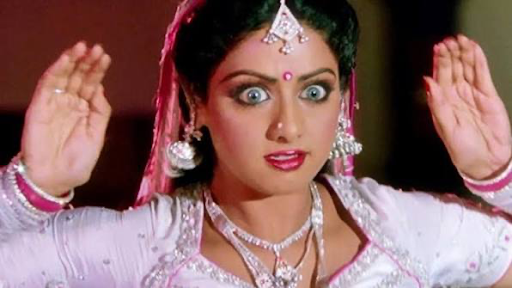
Caption: Sridevi as the titular ‘nagin’, a shape-shifting snake woman, in Harmesh Malhotra’s cult classic Nagina (1986)
The Witches and Possessed Women of Pre-Y2K Bollywood
The most prominent antagonists in pre-2000s South Asian horror films were the ‘dayaan’ or witch, the seductive ‘nagin’ or shape-shifting snake-people from South Asian folklore, and the pious woman haunted/possessed by a malevolent spirit or supernatural entity. The low-budget horror boom of the 1970s and 1980s through the early 2000s, led by filmmakers such as the Ramsay Brothers, Shripal Morakhia, and Vikram Bhatt, often borrowed heavily from the visual and narrative frameworks of American, European, and East Asian horror.
The result was often a strange hybrid of Western and East Asian horror elements transported to South Asian contexts. Ramsay Brothers’ Veerana (1988), for example, adapted the succubus into the figure of the churail, a beautiful woman possessed by a malevolent spirit who seduces and kills men. The Ramsay Brothers capitalised on conservative society’s anxieties about the newly liberated, educated, progressive, working South Asian women of the late-20th century and framed them as the beautiful, sensuous, seductive, supernatural predators preying on men. In a 2018 interview with DNA, Tulsi Ramsay—one of the seven brothers—summarised the formula as “sex, drama, good-looking girls, and fear.” Other films such as Shripal Morakhia’s Naina (2005) “unofficially adapted” the Pang Brothers’ The Eye (2002), combined with a subplot from Hideo Nakata’s Dark Water (2002); and Vikram Bhatt’s original horror trilogy was “inspired by” plot elements and tropes such as the haunted Gothic mansion, the possessed woman, exorcism, family secrets, apparitions, and the climactic revelation of a vengeful female spirit from American horror classics such as What Lies Beneath (2000), The Exorcist (1973), and The Exorcism of Emily Rose (2005).
[Embed: Veerana Trailer 1988 by Ramsay Brothers]
The monstrous woman in these films consequently embodies a contradiction: she represents both transgression and restoration of patriarchal norms. Her sexuality makes her both desirable and dangerous within the story and to the audience. She is terrifying because she is liberated: sexually assertive, physically powerful, vengeful and unwilling to remain within the gender roles traditionally assigned to South Asian women. But that liberation is largely framed through a male gaze. The dayaan, churail, and nagin possess forms of agency unavailable to the respectable heroine, but the narrative generally restores the patriarchal social order by destroying, exorcising, or otherwise containing them. The monstrous woman becomes a projection of patriarchal fear—the fantasy of what a woman might become if freed from the sexual, domestic, and familial restrictions imposed upon her.
In her seminal text, The Monstrous-Feminine: Film, Feminism, Psychoanalysis (1993), Professor Barbara Creed argued that patriarchal ideology imagines liberated women as monstrous in relation to their sexuality and reproductive body to justify their subjugation. Drawing on feminist philosopher and literary critic Julia Kristeva’s theory of abjection from Powers of Horror (1980)—which describes the violent reaction of disgust and horror people feel when confronted with what threatens their stable sense of self, order, and cultural boundaries—Creed argued that horror cinema does not cast women as monsters at random: it repeatedly returns to the female body’s reproductive and maternal functions such as birth, menstruation, and the womb as the original source of dread, because they blur the boundary between self and other, and life and death which the genre depends on for its horror.
The new wave of South Asian horror films echoes Creed’s concept of the monstrous-feminine as a transgression of domestic norms and the idealised notion of motherhood by blurring the boundaries between the divine feminine and monstrous feminine—between the pious virgin-wife-mother-goddess and the equally seductive and repulsive demoness. They portray women both as victims and as vengeful, fearsome, supernatural entities who return to avenge past trauma and social injustice.
Folk Horror as an Archive of Gendered Trauma
Films such as Bhaskar Hazarika’s Kothanodi, Anvita Dutt’s Bulbbul, Megha Ramaswamy’s Lalanna’s Song, Mejbaur Rahman Sumon’s Hawa, and Bhargav Saikia’s Bokshi revisit South Asian folklore as an archive of gendered fears, anxieties, and trauma accumulated over generations.
Hazarika’s Kothanodi (India, 2015), an anthology film adapted from Assamese ghost stories and folktales collected in Burhi Aair Sadhu by Lakshminath Bezbaroa, brings the macabre psychological and gendered subtext of these stories to the surface and examines the patriarchal violence embedded within them. Its fairy-tale universe is populated by grotesque acts of violence against women and children, exposing the darkness hiding beneath the moral certainties traditionally associated with folklore.
[Embed: Lalanna’s Song | Official Trailer | Megha Ramaswamy| Newton Cinema]
Megha Ramaswamy’s Lalanna’s Song (India, 2022) revolves around a brief encounter between two mothers (Parvathy Thiruvothu and Rima Kallingal) and a precocious child (Nakshatra Indrajith as the eponymous Lalanna) at a birthday party. But what seems at first like a polite social visit soon unravels into an ambiguous but undeniably menacing power struggle. Lalanna, a child who is both gifted and othered, becomes a screen onto which the two older women project their fears and anxieties. Her voice—perhaps even her supernatural powers—becomes a source of both awe and alienation. Although Lalanna remains a cypher, the film uses her otherness to examine how society polices those it cannot classify. “Lalanna’s presence is not just symbolic of girlhood; it’s symbolic of survivors and victims,” Ramaswamy said when I interviewed her for Homegrown in 2025. “A lot of us find ourselves being pushed off the cliff quite literally. A few of us survive the fall. The angst is in the lament that the victim/survivor of this crime is never believed despite her repeated pleas. She is a character of mystery only because she speaks a truth.”
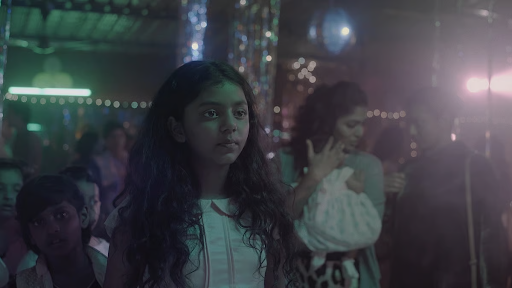
Caption: Nakshatra Indrajith as Lalanna in Megha Ramaswamy’s Lalanna’s Song (2025) / Courtesy of Bridge Postworks
Mejbaur Rahman Sumon’s psychological and environmental horror Hawa (Bangladesh, 2022) takes place on a fishing boat in the Bay of Bengal, occupied almost entirely by men. As the fishermen, led by the veteran Chaan Majhi, venture out to sea, their nets unexpectedly haul in Gulti, a mysterious young woman. Her unexpected arrival unsettles the all-male crew, who treat her as both a bad omen and an object of desire. When the boat’s mast breaks and a series of inexplicable events occur on the boat, the men’s suspicion turns toward Gulti, the only woman aboard. The woman they caught from the sea becomes, in their eyes, the source of everything going wrong. The fishermen repeatedly invoke the ancient sailors’ superstition that women do not belong on boats, framing her presence as inherently contaminating or dangerous. Yet Sumon gradually turns that superstitious gaze back upon the men: they sexualise, covet, and fight over Gulti, while she remains silent for much of the film, leaving the men to fill her silence with their own fantasies. Her inscrutability also pushes the boat’s crew to project their fears onto her as their calculations fail, their catch disappears, and the boat becomes subject to forces of nature beyond their control or comprehension.
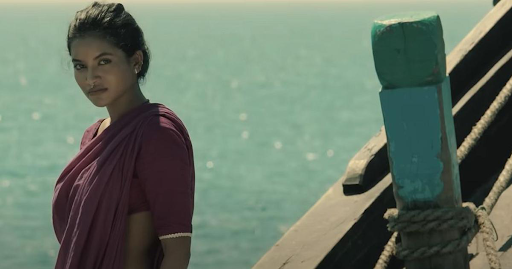
Caption: Nazifa Tushi as Gulti in Mejbaur Rahman Sumon’s Hawa (2022)
The sea, meanwhile, becomes an extension of Gulti’s unknowability. The men believe they understand the water because they have spent their lives navigating it; yet once Gulti arrives, their authority begins to collapse. The sea becomes a counterforce to masculine control—a mythic space where the patriarchal hierarchies of power governing the boat cease to function. The supernatural becomes a mechanism that forces the men to confront the consequences of trying to control what they cannot understand. In Hawa, Mejbaur Rahman Sumon uses an ecofeminist lens to frame Gulti’s resistance to masculine control as a metaphor for the sea’s refusal to be mastered by mankind—turning nature into an agent of justice that punishes the men who violate both feminine autonomy and the ecological order.
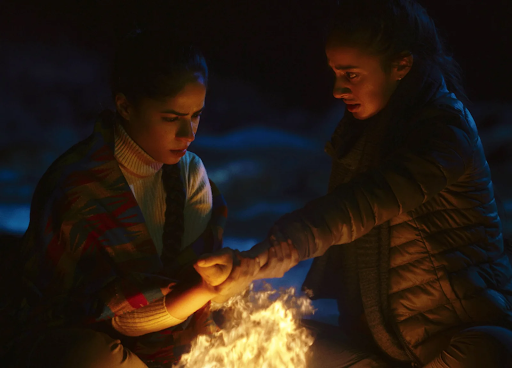
Caption: Drawing on eastern Himalayan folklore and the ‘Wild Woman’ archetype, Bokshi (2025) questions why women whose power, knowledge, or autonomy fall outside patriarchal norms have historically been made monstrous.
Bhargav Saikia’s Bokshi follows 17-year-old Anahita (Prasanna Bisht), a troubled teenager haunted by nightmarish visions about the disappearance of her mother. Bullied at school and emotionally isolated at home, Anahita finds solace with her history teacher, Shalini, when her grandmother sends her to a boarding school. A school excursion into the forests of Sikkim, however, draws the students into an ancient world of prehistoric sites, strange rituals, and stories of the ‘bokshi’—the Nepalese word for witch, sorceress, or a female shaman. As the trip descends into supernatural terror, Anahita discovers that the mythology surrounding the witch is connected to her mother, her own inherited trauma, and the struggle between feminine and masculine forms of power, with Shalini at the centre of it all.
[Embed: Bokshi – trailer | IFFR 2025]
Drawing on eastern Himalayan folklore and the ‘Wild Woman’ archetype, Saikia questions why women whose power, knowledge, or autonomy fall outside patriarchal structures have historically been made monstrous. In Bokshi, Sikkim’s old-growth forests in the eastern Himalayan foothills become a space where suppressed histories persist and where feminine power exists beyond the patriarchal social order that seeks to discipline it. Bokshi is an attempt to reclaim monstrosity as a language of resistance, connecting the policing of women’s bodies and behaviour to the wider systems of masculine domination through which both women and the natural world are controlled. Saikia describes the film as fundamentally feminist, explicitly interested in the origins of patriarchy and the historical persecution of women under the label of “witch”.
The wilderness in these films—the sea in Hawa and the forest in Bokshi—is not simply the opposite of civilisation. It represents a threshold—a liminal space where the violence concealed by civilisation becomes visible. As these films increasingly show, folklore gives filmmakers a language to question the prevailing politics of gender, ecology, and collective memory. Folklore, then, becomes a kind of feminist archive, and its monsters preserve the traces of gendered trauma that official histories have often attempted to repress. The visual language of folk horror enables filmmakers to subvert or invert such predominant patriarchal narratives, which frame women as either the perfect victim or the repulsive villain.
The Blurring Line between the Divine and Monstrous Feminine
Anvita Dutt’s Bulbbul takes the subversion/inversion of the monstrous woman archetype one step further. Historically, the churail, the backwards-footed supernatural entity from South Asian folklore, functioned as a warning against feminine transgression. In Bulbbul, Dutt asks what might have transformed a woman into such a monster.
[Embed: Bulbbul | Official Trailer | Tripti Dimri, Rahul Bose, Avinash Tiwary | Netflix India]
Set in the 1800s, Bulbbul spans two decades of Bulbbul’s life: a child bride, a young adult wife, and a married woman in colonial-era Bengal. The story begins when Bulbbul (Triptii Dimri) is married off to Thakur Indranil Chaudhary (Rahul Bose)—a wealthy, older zamindar or landlord—while she is still a child. At her marital home, Bulbbul feels increasingly isolated as her husband prefers the company of Binodini, the wife of his developmentally challenged identical twin, Mahendra. Alone and neglected, Bulbbul finds companionship in Satya, Indranil and Mahendra’s much younger brother. But when Binodini informs Indranil of his wife’s fondness for his younger brother, he sends Satya to study abroad and subjects Bulbbul to a brutal assault, which leaves her bedridden and vulnerable to Mahendra’s sexual violence. Years later, after Indranil has abandoned the household, now run by an older Bulbbul, a series of mysterious murders of men, including Mahendra, leads Satya, who has returned from London after studying law, to investigate the legend of a churdhail haunting the forest surrounding the village. He eventually discovers that the creature is Bulbbul herself—transformed by the violence she endured into a supernatural avenger.
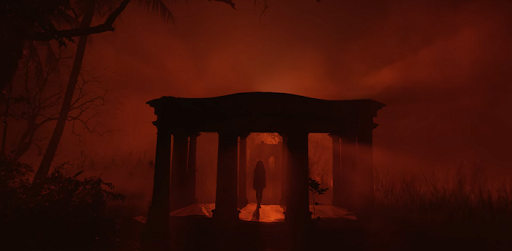
Caption: Bulbbul’s distinct visual language—its saturated reds, moonlit forests, and Gothic interiors of opulent Bonedi mansions—created by cinematographer Siddharth Diwan, turns the fairy-tale world of Bengali folklore into one of patriarchal violence whose moral categories have been inverted. / Courtesy of Clean Slate Filmz/Netflix India.
Dutt’s most significant intervention is inverting the churail archetype. In South Asian folklore, the churail is conventionally a figure of malevolent female sexuality: a monstrous woman whose transgression is symbolised through her uncanny body—often marked by long, unkempt hair and inverted feet. Dutt retains this iconography but changes its underlying logic. Bulbbul’s inverted feet, permanently disfigured and turned backwards at the ankle by Indranil and Mahendra’s assault on her body, are not the physical markers of a supernatural curse; they symbolise the violence perpetrated by Indranil and Mahendra. In Dutt’s retelling, the body that Indranil attempts to immobilise through patriarchal violence is transformed into the body that enables Bulbbul to move beyond its control. The churail becomes a metaphor through which Dutt interrogates the female body as a site of patriarchal violence. The monstrous woman is therefore not an aberration from the patriarchal social order; she is a direct consequence of it. Dutt transforms the conventional binary between the monstrous and the divine, allowing the churail to become, simultaneously, the divine and the monstrous feminine.
The Monstrous Woman as Feminist Antiheroine
The resurgence of women-centric folk, gothic, atmospheric and psychological horror films across South Asia represents a cinematic response to a region experiencing renewed forms of patriarchal overreach: the increasing policing (both moral and legal) of women’s bodies and sexuality, the rise of misogynistic online subcultures, religious extremism, majoritarian politics, and increasingly visible and rampant gendered violence. Drawing on distinct regional folklore, oral traditions, Gothic archetypes, and supernatural legends, South Asian filmmakers like Anvita Dutt, Megha Ramaswamy, Mejbaur Rahman Sumon, and Nuhash Humayun are reclaiming the monstrous feminine as a feminist antiheroine—a mirror image of the divine feminine.
[Block quote: “Myth and folklore have always had very strong feminine and gender-fluid structures that existed before the rules of patriarchy became so fixed in storytelling.” — Megha Ramaswamy]
“Folk horror is closely connected to the divine feminine—a recurring aspect of the female experience in South Asia. Its myths, ghosts, goddesses, and witches offer women filmmakers a way to explore autonomy, desire, violence and gendered power. Because social justice is embedded in the genre, folk horror creates a space where the male gaze cannot fully take over without appropriating something that doesn’t belong to it,” Megha Ramaswamy says.
The resurgence of feminist horror in South Asian cinema suggests that social realism may no longer be sufficient to represent women’s lived realities of contemporary patriarchal violence. Under such circumstances, horror allows filmmakers to make visible the structural, gendered violence of patriarchy that has been so normalised as to disappear into ordinary life in South Asia through metaphor, excess, and the supernatural. In these films, the ghost, witch, goddess, and demoness—the monstrous woman—represent not only objects of masculine desire and fear, but also embody everything patriarchal society attempts to repress: female desire, rage, bodily autonomy, sexuality, reproductive power, and the rejection of patriarchal ideas of womanhood itself.