


Word Count: 2488 | Reading Time: 9 min
The South Asian Speculative Fiction Database Project (SASFdb) is an open-source database designed to help students, researchers, and literature enthusiasts discover the breadth and depth of South Asian speculative fiction. The two wings of the project consist of a tagging wing that is instrumental to visualization, and the visualization tool that allows for a broader study of the South Asian Speculative fiction corpus. SASFdb began in the summer of 2024 when a Professor of English at LUMS hired a few undergrad RAs to create something new. With more questions than answers, the SASFdb team used the first phase of the project to brainstorm new ideas, imagine possibilities for the visualization tool’s final form, and explore the potential waiting to be realized.
Carving our own path, we were faced by some early challenges: how were we to characterize South Asian fiction? How could we put a label on Speculative fiction, and how were we to classify its textual elements? The answers to these initial questions would become the skeleton of the project, forming the backbone of both our conception of South Asian Speculative fiction and a silhouette of the unique tagging system that would honor the genre’s singular multiplicity. The information from these tagged stories was then to be fed into an interactive database where users could filter and sift through various genres, themes, and features, thereby tracing the pulse of South Asian speculative fiction thrumming with untapped research potential. Our rich, semantic tagging scheme would allow the visualization tool to present convergences, commonalities, and correlations over a broad enough research sample to explore trends and trademark styles in South Asian speculative fiction. Answers to these early questions shaped the purpose of the project, both immediate and long-term. We wanted SASFdb to be a serious research tool that could hold the interest of a wider audience. As such, it had to be broad enough to have pedagogical applications, detailed enough to advance scholarly research, and accessible enough to allow non-academics to trace their own patterns and serendipitous discoveries. Given this, we took our time exploring the shape SASFdb ought to take, a team of academics trying to anchor ourselves in definitions sharp enough to be useful but broad enough to stand the test of time.
To clarify our approach, we established a consensus on what we meant by speculative fiction, genre, themes and features. Early in our process, we agreed that the best definition for speculative fiction (or the most serviceable one for our purposes) was one that made room for “radical vision[s] of alternative conditions”, from alternate histories to strange science fictional futures and fantastical realities. Speculative fiction, then, came to be understood as an umbrella term, or a “metageneric fuzzy set supercategory” (as Marek Oziewicz calls it in the Oxford Research Encyclopedias). The choice of “metageneric” accounts for the way that speculative fiction encompasses various sub-genres of fiction engaged in imagining alternative conditions, like science fiction, fantasy, alternative history, to name a few. The term “fuzzy set” characterizes the blurry boundaries that distinguish one subgenre from the other, marking the porosity and play of genre features that South Asian Speculative fiction engages in.
The blurry, fuzzy, broad speculative fiction of Oziewicz’s theory provided us with an approach for constructing a tagging taxonomy and creating workable definitions for the team that would not only honor the core tenets of SASFdb but place them squarely at the helm of the project. The question of genre (under the wider gamut of speculative fiction) demanded the same generous and sensitive approach, here taken to be a descriptive approach of genre over a prescriptive one. Like traces, hints, and hues that shaded in and out of texts, we wanted to describe genre like a tendency whose current flowed within a story, instead of being a category we could box a story inside, closing the lid forever. The very notion of descriptive genre tendencies was inspired by Carl Freedman’s Critical Theory and Science Fiction as “something that happens within a text” (20) instead of a text being prescribed a genre. This idea of genre as a tendency rather than a box counters the oversimplifying effect of genre labels, which often become reductive, failing to account for the unpredictability and novelty of genre writing. Our descriptive approach celebrates the multiplicity and intermingling of various, often contrasting genre markers within a single work of fiction, which characterizes much of contemporary South Asian speculative fiction. Having encountered such new terrain, we recognized the necessity of standardized genre descriptors as the language of our map, and not necessarily the final shape of it.
Playing with genre’s easy miscibility, the SASFdb team recognized the potential of genre-blending that South Asian Speculative fiction writers dabbled in and resolved to capture this playfulness in a broad conception of how to tag genre, giving rise to genre tendency tags instead of binary genre classifications. For the purposes of the visualization tool, we developed primary and secondary genre tags, allowing for the play of generic conventions that are present to a greater or lesser extent within a text. The secondary genre tendency tags also account for sub-genres outwith speculative fiction, therefore making edge cases and unlikely combinations easier to spot and analyze across the South Asian speculative fiction corpus. Through filter and search tools, users and researchers may, for example, find magical realism texts that feature gothic tendencies. The open-ended nature of the tags allows the research tool the flexibility to accommodate any question that its user can imagine or wish to pursue.
How would we put this approach to use, especially when it comes to defining genre? The multiple contesting definitions of what qualified or constituted science fiction, for example, felt too restrictive to do the imaginings of South Asian writers any justice. Darko Suvin, a science fiction theorist, characterized “cognitive estrangement” as a defining feature of science fiction texts in his essay “On the Poetics of the Science Fiction Genre”, while Ernst Bloch’s theory focuses on the perpetual “not yet” of science fiction. Steven Shaviro, theorizing science fiction 50 years after Suvin’s essay, draws from Bloch for his concept of futurity or “cluster of possibilities” (7) that science fiction texts chiefly engage with. Shaviro’s futurity lent our project the flexibility we needed in conceiving of science fiction imaginings. Despite the conceptual rigidity of Suvin’s “Cognitive Estrangement”, this notion gave us a term (and tag with its own sub-tags) to define how South Asian Speculative fiction diverges from base reality.
Because the very nature of speculative fiction is one that “deliberately depart(s) from imitating “consensus reality” of everyday experience” (Oziewicz), it follows that there must be certain markers that allow fiction to become “speculative”. These markers are useful in tracing the trajectory of potentialities across south Asian speculative fiction. Using Suvin as a starting point, we understand these potentialities to be elements of “cognitive estrangement”, deserving of their own space in the database and visualization tool since they explore the social, political, and economic implications of a world changed by one (or more) speculative element. Cognitive estrangement, according to Suvin’s narrow definition for science fiction, is the necessary and sufficient condition for texts to be considered science fiction. If a text diverges from base, empirical reality and can rationally account for this divergence (in keeping with the scientific logic of the present day), then it qualifies as science fiction. As this is a rather reductive and strict definition, many soft science fiction texts fall outside of it because it makes no room for epistemes beyond the “Western” rational one. Despite these theoretical shortcomings, the SASFdb team saw merit in adapting “cognitive estrangement” as a theoretical construct to classify and describe the way South Asian Speculative fiction texts represent unfamiliar elements and realities.
In the context of our framework of the tagging process, and the database used by the visualization tool, it is crucial to highlight the ongoing development of the three-tier tagging system that structures how we approach our analysis.
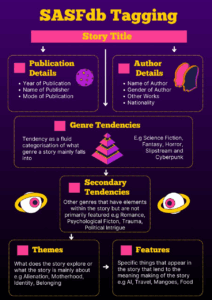
(Image Credit: Khadija Salman, SASFdb Tagging Manager)
Our aim was not to create a comprehensive, catch-all tagging taxonomy, but to explore what made sense in the context of facilitating connections and remaining true to the descriptive style of our project. Tier 1 information includes factual information regarding the story, i.e its publication date, details of the author like name, nationality, profession, and other published works, as core level information. Tier 2 then moves on to high level analytical information about the story, starting with a brief synopsis, genre tendencies (both primary and secondary), story themes, and cognitive estrangement feature. Last but not least, we have tier 3 cataloguing the rich semantic details and nitty gritty features of the story that connect to genre and theme. These details are the most complex and interesting elements in our database not simply because they point towards certain genre tendencies (e.g. time machines for science fiction stories, magic potions for fantasy stories) but because they capture the specific South Asian imagery within speculative imaginings. Nudrat Kamal’s article on South Asian Science Fiction and Fantasy describes how South Asian writers are “appropriating, remixing and upending Western SFF tropes to explore concerns that are firmly situated within South Asian history, culture and politics, using imagery and motifs that are distinctly desi”4. Such desi imagery and motifs are what tier 3 tags aim to represent, while the broader thematic concerns fall into tier 2.
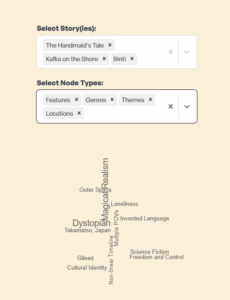
Caption: The word cloud feature filters and displays tier 2 and 3 information from any combination of South Asian short stories in the database.
Running parallel to the theoretical stream, our development team worked on the nuts and bolts of the SASFdb visualization tool through phases II and III. Initially, we drew inspiration from Uta Hinrichs and Stefania Forlini’s “Speculative W@anderverse” project, and the ways that this tool visualized the Bob Gibson Science Fiction anthologies. For our engineering team, the idea of constructing a similar interactive, research-driven visual interface from scratch was a challenge. Our main conclusion from studying W@nderverse was that we wanted to center user experience as part of our design. SASFdb had to be useful as an accessible and detailed research tool, not simply as an exhaustive map of the corpus. This principle continues to shape many of the decisions made to this day.
The SASFdb tool as it stands features 4 main visualization modules to represent information from the three-tier tagging system.
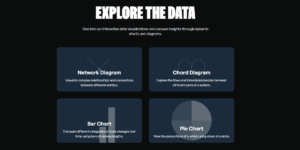
It was a challenge to decide how we would split the data across different kinds of visualization. Information is only as good as its readability, and the wrong visualization can bury meaning under complexity. We eventually settled on the pie and bar charts because these users would be most familiar with these visualizations, while the chord and network diagrams are more nuanced and unique visualizations. We have the chord diagram for depicting correlations between tags across stories. The heart of our tool is the constellation visualizer (Network Diagram), displaying tags as nodes in a network that the user can expand and shrink as they desire. We devised the constellation model to replace the initial radial tree scheme (inspired by W@nderverse) because the latter would only end up overwhelming the user if they included more than a handful of stories. As SASFdb may end up covering thousands of stories, the constellation model is cleaner and more configurable, making for a more intuitive user interface.
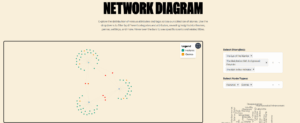
Caption: Our constellation visualizer depicting the relationship between information from tiers 2 and 3.
As the database grew from a few stories to an expansive collection complete with connections and generic or thematic overlaps, more and more avenues of inquiry unfolded. With each fantastic voyage into the work of a south Asian speculative fiction writer, we devised new ways of capturing and representing the weirdness that we discovered. New stories meant new tags to accommodate the fusion of languages, genres, and settings. We developed a taxonomy of cognitive estrangement so that the “strange newness” of each story could be charted and compared to other stories. In accounting for a wide range of possible research avenues, we developed a system to enable many kinds of inquiry, from broad biographical or publication information to the semantic minutiae of the literary work.
The next phases of SASFdb will see our team branching out into stories that were not published in English, so that stories with South Asian source languages may also be included in our database. The medium-term goal of stories that are yet to be translated poses an entirely new set of challenges, involving the craft of translation and the conception of South Asian speculative fiction that takes its shape according to the linguistic features of Urdu, Hindi, Punjabi, and so on. This phase would also cause ripple effects down to granular tier 3 features, opening up an unexplored field ripe with specific South Asia literary characteristics. Beyond this, we aim to make the project publicly accessible, which involves making the user interface as seamless and enjoyable as possible. Our long term—and more ambitious— goal involves integrating natural language processing to replace the current drop-down menu feature. This would allow users to type their own queries, rather than sifting through the options. As SASFdb expands in its scope, choosing stories from the drop-down features might become arduous, in which case the option to type out one’s queries would be more efficient. Our development team has begun exploring how LLMs could facilitate natural language processing, but we are currently looking for partners in the data science space who can aid in implementing some of our more ambitious plans.
As a research tool, the vision of SASFdb is as a means to an end, instead of an end in itself. It is the first attempt at making visible the seams and fault lines between and among South Asian speculative short stories. At the moment, our corpus is drawn from both Tasavvurnama and the Gollancz Anthologies of South Asian Speculative Fiction, but the future is bright with many more stars in the firmament yet to be named.
If you’d like to receive news and updates on our project, please click here to be added to our mailing list: https://tinyurl.com/499px5cv
Citations
http://www.utahinrichs.de/Projects/SpeculativeWanderverse
Freedman, Carl. Critical Theory and Science Fiction, Wesleyan University Press, Middletown, CT, 2000
Suvin, Darko. “On the Poetics of the Science Fiction Genre.” College English, vol. 34, no. 3, 1972, pp. 372–82. JSTOR, https://doi.org/10.2307/375141. Accessed 28 July 2024.
Suvin, Darko. “Science Fiction and the Novum”, Epistemologia, 1977, https://www.academia.edu/85920683/Science_Fiction_and_the_Novum_1977_8_830_words_
GILL, R. B. “The Uses of Genre and the Classification of Speculative Fiction.” Mosaic: An Interdisciplinary Critical Journal, vol. 46, no. 2, 2013, pp. 71–85. JSTOR, http://www.jstor.org/stable/44030329. Accessed 29 July 2024
Oziewicz, Marek. “Speculative Fiction”, University of Minnesota, 29 March 2017, https://doi.org/10.1093/acrefore/9780190201098.013.78
Kamal, Nudrat, “What South Asian Sci-Fi Can Tell Us About Our World”, Dawn Prism, July 2019. https://www.dawn.com/news/1493449/what-south-asian-sci-fi-can-tell-us-about-our-world